
The Pearl of Africa boasts over 1,100 species of birds, 20 primates and several well-preserved national parks, hosting some of Central Africa’s otherwise inaccessible rarities. Africa’s largest lake, the source of the Nile, and the world’s most powerful waterfall, all add to the country’s allure. I’d been wanting to visit for some time and in August 2025 an opportunity arose.

Shoebill, Mabamba Swamp, Lake Victoria
Researching Uganda’s key birding destinations suggested that a minimum of a month would give one a sporting chance of seeing half of their birds. Adding 50% (another two weeks) would allow me to return with a reasonable collection of pictures. I split the total of six to seven weeks into three distinct trips, connecting the hotspots from the capital, after visiting the nearby Mabamba Swamp and Entebbe Botanical Gardens:
- Northwest: Royal Mile and Nyabyeya fields, Murchison Falls National Park, Kibale NP and Bigodi Wetland Sanctuary, and Semuliki NP
- Southwest: Bwindi Impenetrable Forest NP, Rwenzori NP, Queen Elizabeth NP, Mgahinga NP, and Lake Mburo NP
- Northeast: Mabira Forest, Pian Upe NP, Mount Elgon NP, and Kidepo NP
This Field Note covers the first route, a 16-day circuit from Kampala heading northwest and returning east for our departure flight. Due to the underdeveloped road network and urban traffic congestion, three of the 16 days were purely transit, while two shorter transfer days permitted some roadside birding.
I chose Cisticola Birding, led by Matthew Kajungu, to arrange our affordable tour. Matthew organised a comfortable vehicle, suitable lodging, and skilled local guides for our forest trails, making the experience seamless. I highly recommend him for private tours in Uganda; his extensive experience and network of industry colleagues ensured that our trip went perfectly.
A few weeks prior to my departure, I went cycling with friends. At our compulsory coffee stop one friend mentioned that his father had always wanted to visit Uganda to see the Shoebill, Murchison Falls, and chimpanzees. Who wouldn’t? He is more than welcome to join me, I said, and before I knew it, Corrie Meintjes, retired civil engineer nearing 80, had booked his flight, secured his evisa, and was charging his camera batteries. In no time we’d be reliving the day’s highlights over a cold Nile lager while plotting our plans and wish list for the following day.
We arrived in Entebbe from Johannesburg with Uganda Airlines. We used U.S. dollars and some locally drawn shillings for tips and small purchases, while other costs were prepaid. Matthew and our driver Ronald Rugira picked us up, and we had dinner at the nearby Airport Hotel – our home for two nights - before starting early the next morning. Matthew kindly provided a connectivity hotspot for the duration of our stay.
Our route (see map below) was as follows:
- Mabamba Swamp (A) and Entebbe Botanical Gardens (F) – 1 full day
- Royal Mile (B) – 2 full days
- Murchison Falls National Park (C) - 2.5 days
- Kibale National Park (D) and nearby Bigodi Wetlands - 3 full days
- Semuliki National Park (E) – 3.5 full days
- Return to Entebbe Airport (F)
Despite the long muddy treks, tricky log crossings, bugs, and brambles, Corrie loved it all. Truly inspiring, he doubled the number of summers I thought I had left.

Eastern Plantain-eater, Entebbe Botanical Gardens

Orange Weaver, Entebbe Botanical Gardens

Mabamba Swamp and Entebbe Botanical Gardens
Many first-time birders to Uganda begin their tour with a trip to Mabamba Swamp, a 20-minute ferry ride and a half-hour drive away. At this papyrus wetland, former fishermen now work as bird guides, and the area is known for its population of Shoebills. Sightings are almost guaranteed. Genetic research has indicated that these Jurassic-looking birds are most closely related to pelicans and herons. We spent about 20 minutes with two individuals, larger, more arresting than I expected. One took to the wing, reminding us that they could fly.
During our three-hour excursion, we counted 59 birds including Purple Swamphen, Blue-breasted Bee-eater, several weavers and warblers, African Marsh Harrier, Little Bittern, Blue-headed Coucal, numerous waders, and other more-common birds.
After lunch at the cooler Entebbe Botanical Gardens, we added Black-and-white Casqued Hornbill, Great Blue Turaco, Bat Hawk, Snowy-crowned Robin-Chat, Orange Weaver, Pale-throated Greenbul, and Eastern Plantain-eaters, bringing our total to 72 birds on the first day.
To Masindi, the Budongo Forest’s Royal Mile, and the Nyabyeya agricultural fields
There was no bypassing Kampala’s standstill traffic, nor the many potholes spoiling Uganda’s long roads. Lunch included a successful stop to look for the magnificent White-crested Turaco.
Another stop at a wetland near our destination produced Yellow-mantled Widowbird, Bar-breasted Firefinch, Magpie Mannikin and colourful sunbirds (Copper and Olive-bellied).
We stayed at Kabalega Resort near Masindi for three nights, giving us two full days to explore the Nyabyeya fields and the renowned Royal Mile in the Budongo Central Forest Reserve (in turn, part of the Murchison Falls Conservation Area). This ancient tropical forest is home to over 360 bird species including sought-afters like Chocolate-backed Kingfisher, Uganda Woodland-Warbler, White-thighed Hornbill, and the tricky Puvell's Illadopsis and Ituri Batis.
We met our local guide, Raymond Ogen, in the Nyabyeya fields near his village. It was an introduction to the exceptional expertise and dedication of Uganda’s bird guides. The early morning fields were alive with grassland birds: newbies included Compact Weaver, Brown-backed Scrub Robin, Fawn-breasted Waxbill, Northern Red Bishop and Heuglin’s Spurfowl. Marsh Tchagra posed briefly, whilst the Brown Twinspot – a beauty I dearly wanted to capture - escaped my viewfinder.
Our weaver wanderings took us past the picturesque Lady Queen of Poland Catholic Church, built by Polish refugees at the end of World War II, and still used today.
A little further down the road is the famous Royal Mile, a picture-perfect jeep track cut by King Kabalega’s military for ceremonies and hunting, and to escape British colonialists in the late 19th century. Bordered by ancient tall hardwoods, and criss-crossed by forest trails, it is also home to some 600 chimps and other primates.
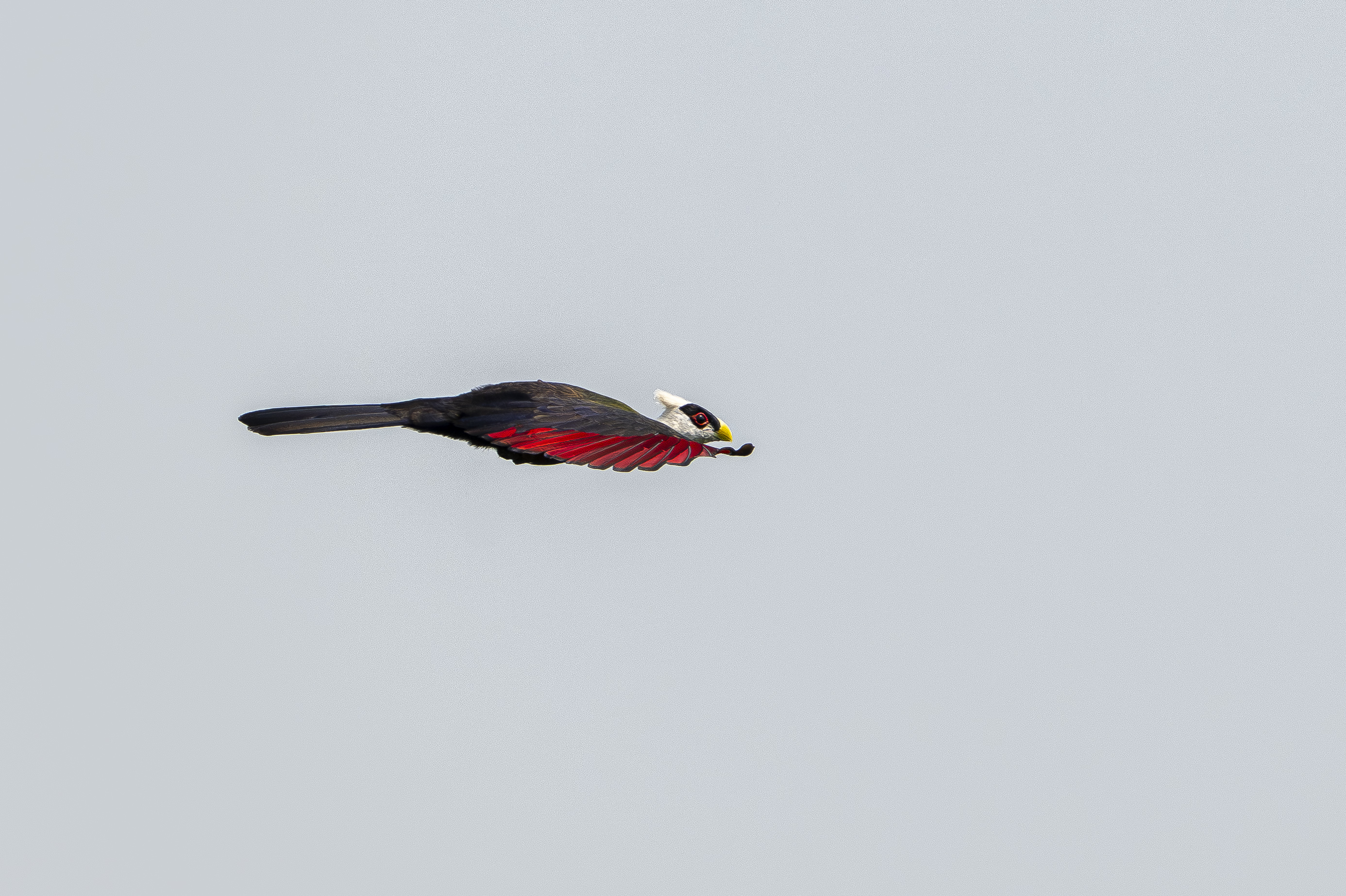
White-crested Turaco near Masindi

Grey-headed Oliveback near Masindi
Raymond identified every movement and sound. Those we had good views of in the first few hours included Chestnut-capped Flycatcher, Yellow-crested Woodpecker, Yellow-throated Tinkerbird, the spectacular Yellow-billed Barbet, dainty Chestnut Wattle-eyes, and Red-bellied Paradise Flycatcher. Corrie saw his first Narina Trogon, while I waited in vain for a Nahan’s Partridge to emerge from the foliage.
The world’s smallest kingfisher (African Dwarf) – all ten grams of it – posed nonchalantly in a dark thicket. Thank goodness it was still. Olive-green and Yellow-browed Camaropteras punctuated the chorus, and the list of lifers, many just too hard and quick and high and poorly lit to photograph, soared: Grey-throated Tit-Flycatcher, African Shrike-flycatcher, African Forest Flycatcher, Western Nicator, Spotted Greenbul, and Little Green Sunbird.
There were birds from families I’d never seen: Grey Longbill, Crested and Red-headed Malimbe, and Red-tailed Ant Thrush. I failed to photograph one of Africa’s “easier” flufftails: White-spotted. Twice! Tall, dark canopies and darker undergrowth meant high ISOs and slow shutter speeds. It was challenging photography, but this day, in the fields and forest, set a record for the number of lifers I’d ever seen in one day: 27. We were over the moon.
We returned, the next day, hoping to photograph the twinspot in the fields, and the Chocolate-backed Kingfisher in the forest, the first bird on my top four list. We’d heard it much of the previous day and strained our necks for a glimpse, without joy. My Merlin Bird ID app was spot on: “A ventriloquial forest kingfisher that is more often heard than seen as it perches in the subcanopy.” After the previous day’s efforts, I’d resigned myself to missing this one.
Again, the fields offered up lifers and photographs: Black Bishop and Grey-headed Oliveback, whilst the forest slowly responded to our efforts with Red-tailed Greenbul, Sabine’s Spinetail, Purple-headed Starling, Little Grey Greenbul, and Sooty Flycatcher.
We lunched on the wooden bridge at the end of the track, overlooking a stream, saddened to be leaving this idyllic forest, when Raymond noticed a bird flit in and land nearby. With a huge smile on his face, he pointed to the kingfisher of our dreams, perched a few meters away, unconcerned by our urgent excitement. It was high fives all around and celebratory cold beers as soon as we got back to the lodge. We left Masindi with our species list on 154.

Chocolate-backed Kingfisher, Royal Mile in the Budongo Forest
Murchison Falls National Park
We reached the park’s southern gate in good time. A chimpanzee carrying its infant crossed the road and vanished into the dense forest. As we descended a steep pass, the vegetation shifted from tall hardwood jungle, to rolling grasslands, palm woodlands, savannah and thornveld. Grey Kestrels were common, and a Western Banded Snake Eagle perched good-naturedly.
The modest but comfortable Hornbill Lodge, just beyond the park’s northern boundary, would accommodate us for the next three nights. Their gardens were bursting with birds but don’t stray too far or too late - elephants wander through to the Nile, 200 metres away.
The mighty river surges through a 7-meter-wide gorge at the park’s eponymous falls, making it the most powerful waterfall in the world. I was last there 31 years ago, on an overland route from Cape Town to Cote d’Ivoire, unaware that a few weeks after we’d left Rwanda, one of Africa’s saddest periods would grip the region.
Previously, there were no barriers, and we relaxed in a rockpool at the fall’s edge. Now, Brown-throated Wattle-eyes sang along a well-worn path and Rock Pratincoles gathered by the water, but swimming near the cliffs was not an option.
Three decades ago, the country was recovering from political turmoil and a war that had drastically reduced its wildlife. Now, the park is teeming with oribi, Jackson’s hartebeest, Uganda kob, Rothschild’s giraffe, buffalo, and elephant. On a night drive, we spotted a zorilla!
The next day we took a private boat upstream towards the falls. The power of the turbulent rapids as you near the chasm is matched only by the size of the Nile crocodiles lounging on the river’s banks. We had wonderful sightings of Red-throated Bee-eater, African Skimmer, Palm-nut Vulture and Osprey.

Red-throated Bee-eater, Murchison Falls National Park

Abyssinian Ground Hornbill, Murchison Falls National Park
The number of species observed, as well as lifers and gallery additions, increased rapidly at Murchison Falls. Established in 1927, this national park encompasses nearly 4,000 square kilometres, making it the largest in the country. Numerous sightings included the colourful Abyssinian Ground Hornbill, Double-toothed Barbet, Black-headed Gonolek, Beautiful Sunbird, and Nubian Woodpecker. The Black-billed completed the wood dove set - I thought they were Emerald-spotted until I took a closer look. The list continued: Northern Crombec, Speckle-fronted Weaver, Shelley’s Sparrow, Vitelline Masked Weaver, Black-billed Barbet, Senegal Thick-knee, Black-backed Cisticola, and a pair of Rüppell’s Vulture flying closely overhead.
The Northern Carmine Bee-eater, a highlight for birders, eluded us on day one, but not day two, thankfully. With our bird count on 214, we turned our 4x4 south. Murchison Falls had added 60.

Northern Carmine Bee-eater, Murchison Falls NP
Kibale National Park and the Bigodi Wetland Sanctuary
A day’s transfer took us to what is billed as the Primate Capital of the World. Chimp trekking in the forest is popular, and Corrie took a morning out to see them. Another dozen species of Uganda’s 20 primates inhabits the reserve. I’d come for the many unique birds found in this area, with the Green-breasted Pitta (second of my top four) heading the list.
Hopeful, we set out the next morning with our local guide, Murungi Davis Barya, and two Uganda Wildlife Authority (UWA) guards. We found a pair of pittas, but our glimpses were fleeting. The only other bird we saw that morning was a Scaly-breasted Illadopsis, a skulking ground creeper. We returned in the afternoon, giving three elephants on our path a wide berth, but couldn’t relocate the pittas. Red-tailed Bristlebill, Green Hylia and a Dusky Long-tailed Cuckoo whizz-by were welcome additions to our list.
The extensive gardens at Chimpanzee Lodge, during our lunch-time break, made up for some of the day’s drought. It added the Green White-eye, African Blue Flycatcher, Red-throated Rock Martin, Bronze and Purple-banded Sunbird.
We decided to try and improve our haul the next day by avoiding the forest and walking the Bigodi Wetland Sanctuary’s trails. This mix of community agricultural fields, swamps, and open forest was far more generous. Quiet and unassuming, Davis was fantastic, knowing every nook of the swamps and fields, as he did, of the dark forest on the previous day. Our list stretched, and memory cards filled: Black-and-white Shrike-Flycatcher, Black-necked Weaver, Ross’s Turaco, Little and Slender-billed Greenbul, White-breasted Nigrita, an eye-popping Shining-blue Kingfisher and unstoppable Red-headed Bluebills.
The day’s highlight was photographing another of my top four. I’d hoped to see a Papyrus Gonolek in Rwanda a couple of years earlier, and Matthew had tried a few spots over the past week, but to no avail. Davis came to our rescue on the wetland’s boardwalks. We were thrilled.

Papyrus Gonolek, Bigodi Wetland Sanctuary
Our third full day was a mix of roadside forest birding, time in the wetlands, and a refreshment stop at a nearby lodge with a bird-friendly garden. The combination supplemented our list with many mouth-watering PlusOnes including Yellow-mantled Weaver, Narrow-tailed Starling, Grey-throated Barbet, the forest stream dwelling Cassin’s Flycatcher, Green-headed, Green-throated and Blue-throated Brown Sunbirds, Hairy-breasted Barbet, Speckle-breasted Woodpecker, a pair of confiding Buff-throated Apalises, and last of the top four: the striking Black Bee-eater.

Buff-throated Apalis, Kibale National Park

Copper Sunbird, Kibale National Park
I’d concocted the top four list in my mind whilst swiping through my guide to East African birds app. They seemed the most beautiful in a very long pageant. But I’d be leaving Kibale without photographic evidence of the bee-eater and the pitta. What were the chances that our last stop would change our fortunes? Kibale and Bigodi had served up an additional 47 birds, a handful of mammals, and an exquisite snake, so we certainly weren’t complaining.
Semuliki National Park
I recall, many years ago, turning the pages of my guide to East African birds, and every few pages there would be a bird that could only be found in a little red dot on the distribution map, close to the DRC border. Same dot, and the only place in East Africa to see it. My interest piqued, I delved deeper on a bigger map, and Semuliki National Park quickly rose to the top of my list of African destinations to visit. It was Semuliki that prompted this Ugandan birding adventure.
It’s not far from Kibale (85km), but the road is slow. We dropped down from the mountains to the lowland tropical forest, bordering the Congo basin. The park hosts a plethora of species – three dozen – that don’t occur elsewhere in East Africa. Finding them in the troubled Congo would be a lot harder.
We collected our local guide, Alex Turyashemererwa, en route, and started birding just outside the park with excellent views of Grey-headed Nigrita, Blue-breasted Kingfisher, Whistling Cisticola and Western Nicator. Toro Olive Greenbul took longer to see. A Speckled Tinkerbird was nesting in the UWA rondavels at Bumaga Campsite – our modest stay for the next few nights.
Later that afternoon we were introduced to some of the region’s specials: the exquisite Orange-cheeked Waxbill, and some of the hornbills that the area is famous for: Piping, African Pied and Black-casqued, best seen from the road bordering the park. Motorcycles would pass us blaring what sounded like political campaigning but turned out to be advertising: “Buy my chapatis – they are warm and sweet like mashed banana in Kampala, and as big as elephants’ ears”.
The next two days would complete the suite of hornbills: Red-billed, the secretive Long-tailed and the rarely seen Eastern Dwarf. Quite a coup, it seemed. Alex hadn’t seen the latter for a while.

Black-casqued Hornbill, Semuliki National Park

Orange-cheeked Waxbill, Semuliki National Park
In addition to over 400 birds, Semuliki is known for its unique mix of Central and East African species, primate diversity, and the bubbling Sempaya Hot Springs. The forest is lush, warm and humid, making it ideal Congo Serpent Eagle country, if you’re lucky. It should be more popular with birders, but access and infrastructure make it harder to visit than many of the other forest reserves in Uganda’s west.
Alex was a ball of energy. We flattened the forest’s paths over three days with all-too-brief lunch breaks. There was just too much to look for.
I didn’t raise my hopes too high – forest birding is tough – but Semuliki surpassed our expectations. Despite our efforts, we didn’t find the last of the country’s dozen kingfishers (White-bellied), or the Hartlaub’s Duck at the oxbow lakes deep in the forest, and Blue-throated Rollers were absent. But in our meanderings, we had incredible views of rarities that included Spotted Honeyguide, Rufous-bellied Helmetshrike, Blue-headed Crested Flycatcher, Brown-chested and Fire-crested Alethes, and Yellow-throated Cuckoo. Yellow-throated Nicator completed my photographic record of all three nicators, tricky African forest inhabitants.

Rufous-sided Broadbill, Semuliki National Park
Alex even knew of a Bates’s Nightjar, whose distribution looks like a map of the DRC with tiny spillovers into some neighbouring countries, like Uganda's Semuliki. It sometimes perched a kilometre into the forest down a muddy elephant track. After dark, in a swarm of mosquitos, of course. Thankfully, we found it on our second attempt.
Chestnut-breasted Nigrita, White-tailed Ant Thrush, Leaf-love and Fraser’s Rufous Thrush extended our list, but the pripping wing rattle of the dainty Rufous-sided Broadbill stole the day.
Semuliki was the perfect finale. Although it was frugal with Black-billed Turaco, some of the more skittish hornbills, and many others, it did give us another shot – successfully this time - at the Green-breasted Pitta and the Black Bee-eater. We couldn’t have asked for more in our three days there.

Green-breasted Pitta, Semuliki National Park

Black Bee-eater, Semuliki National Park
We saw 298 birds in our 16-day northwestern Uganda excursion and I was elated to be adding 88 species to my gallery. Thank you, to:
- Uganda, for your warm hospitality, fascinating and diverse cultures, delicious lake fish, and for preserving many of East and Central Africa’s birds in well-managed reserves, making them accessible to visitors;
- Matthew and his team, and the local community guides, for taking such good care of us; and
- Corrie, for stepping into the unknown with me. What a thrilling adventure that was.
I will be back. Webale nyo.