
Mozambique is home to nearly 800 bird species. Its only endemic bird, the Namuli Apalis, is found exclusively on Mount Namuli - the country’s second-highest peak in Zambezia Province. South of the Zambezi River lies Sofala Province, boasting Gorongosa National Park and the Marromeu Complex, and further south, forest patches in Inhambane Province host the region’s only sites for Green Tinkerbird and Olive-headed Weaver.
Mount Gorongosa is the only place in Southern Africa to see the magnificent Green-headed Oriole. Situated in Gorongosa National Park, spanning 4,000 km2, the park is widely considered Mozambique’s most remarkable conservation achievement.
The Marromeu Complex
The achievements of the Marromeu Complex, led by the founders of Coutada 11, are equally impressive. This initiative employs a model that brings together private stakeholders, local communities, and government entities, with financial support from philanthropists, hunters, and to a lesser extent, birdwatchers. The outcomes are clear: mammal populations have significantly increased, in several cases surpassing pre-civil-war levels. Returned residents benefit from essential community infrastructure, including a school, clinic, cultivated plots, a mobile mill, assistance with apiculture, and regular meat distributions. Additionally, indiscriminate poaching has been largely curtailed and deforestation for charcoal production and agriculture has been halted. These measures have preserved trees and wetlands, which are vital for avian nesting and foraging. As a result, critical biodiversity is thriving.
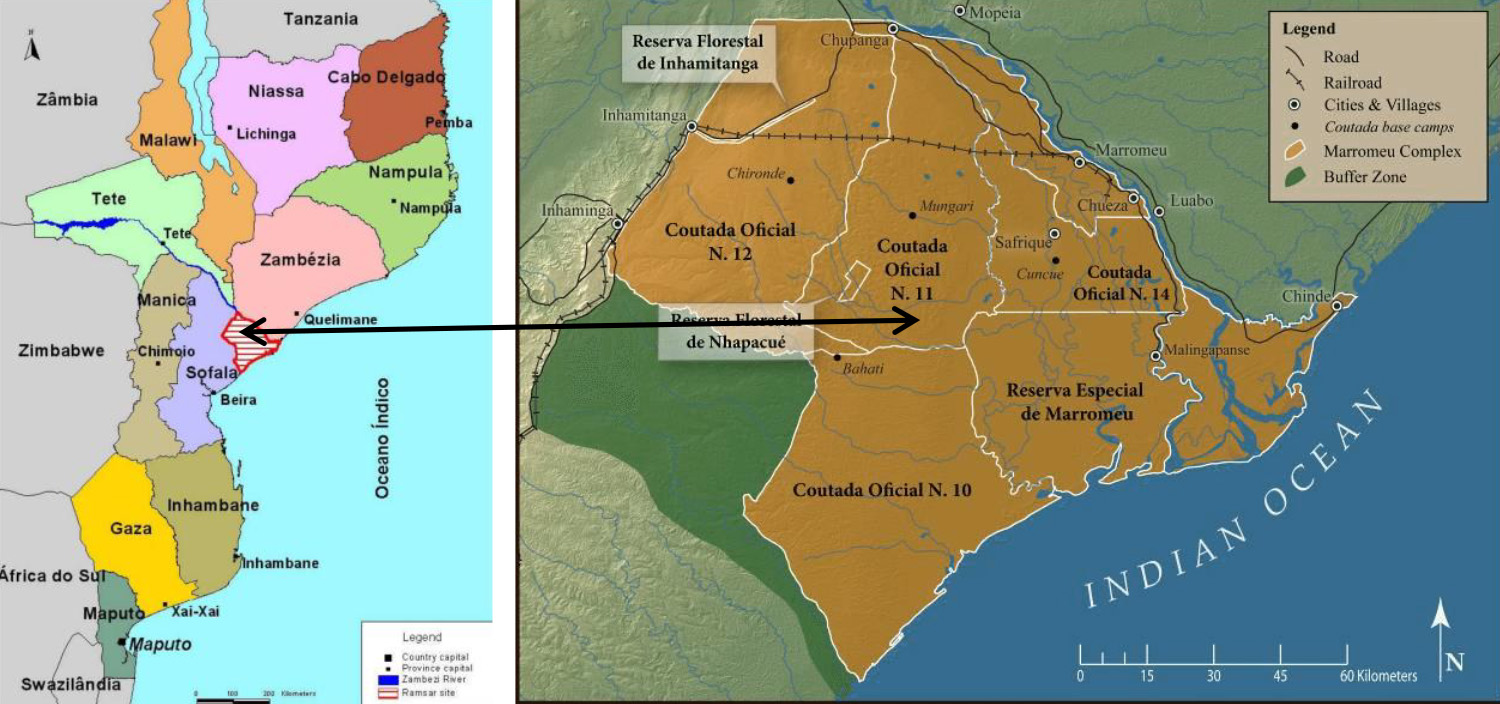
The complex forms the northeastern edge of Southern Africa’s birding region, making it an important destination for birdwatchers, with over 300 recorded species.
Located on the southern bank of the Zambezi River near its delta with the Indian Ocean, this area is home to numerous sought-after species, including the East Coast Akalat, White-chested Alethe, Lesser Seedcracker, and the migratory African Pitta. Furthermore, the region offers exceptional game viewing, with successful reintroductions of both lion and cheetah.
It is the older of the nation’s two Ramsar (wetland) Sites, designated in 2004, and covers some 11,000 km² of largely unspoilt habitat, including sand forests and miombo woodlands, seasonally flooded grasslands and freshwater papyrus swamps, all fringed by a mosaic of rivers, coastal dunes and carbon-sequestering mangroves.
The complex consists of the protected Marromeu Game Reserve, four regulated hunting concessions (Coutadas 10 to 14), and buffer zones. Hunting, permitted from April to November, is strictly managed, allowing concession holders to finance conservation initiatives such as research, wildlife management, anti-poaching efforts, and benefits for local communities.
Getting there
Birding is best during the wet season (October–March), when migrants arrive and the landscape is lush, though heavy rain can pose challenges. The range of habitats is first appreciated during the one-hour flight from Beira. The area supports Southern Africa’s largest Great White Pelican breeding colonies and serves as a vital site for the endangered Wattled Crane.
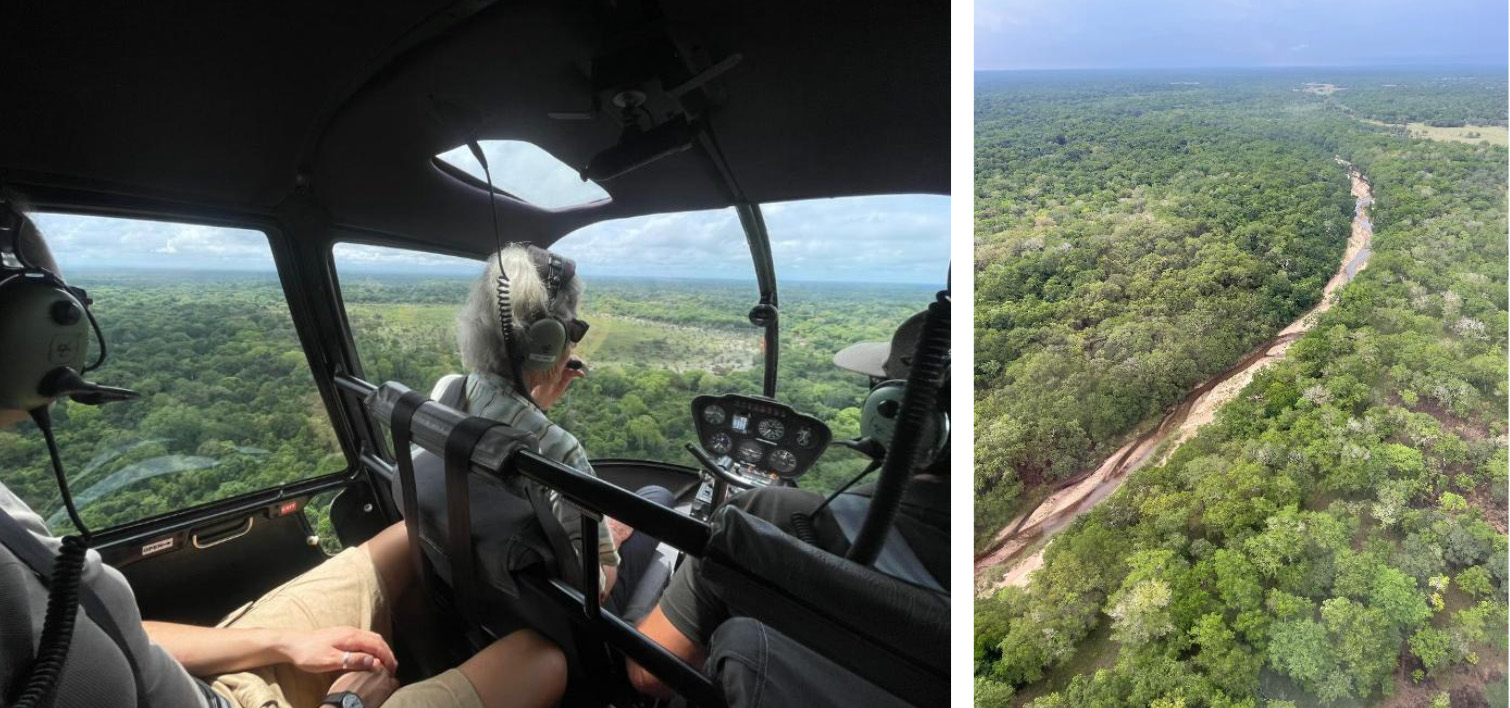
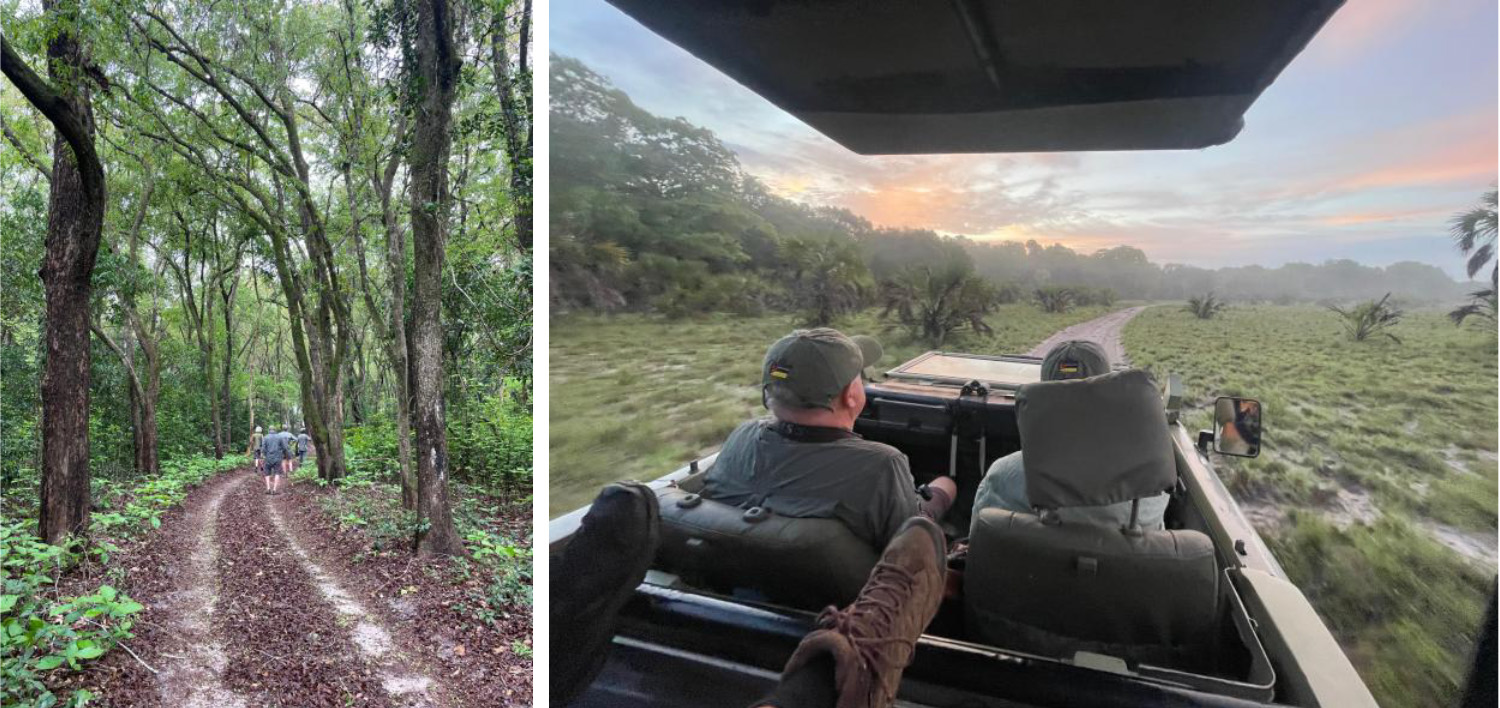
The region's notable attractions were accessed via one of John Robinson’s guided birding tours to Coutada 11 (https://robinsonbirding.com/). Airlink (from Johannesburg) and Ethiopian Air fly to Beira and the camp is then reached by charter helicopter or a small fixed-wing aircraft, offering impressive views along the way. Self-driving within the coutadas is prohibited.
During a six-night stay in well-appointed en-suite safari tents under an all-inclusive arrangement, I was accompanied by my daughter and four other enthusiastic guests. We listed over 160 bird species, including several notable first sightings. The area supports healthy populations of mammals rarely observed further south, such as Lichtenstein’s hartebeest, Crawshay’s zebra, and sable antelope.
John has led these safaris for many years, possessing extensive knowledge of the local trails and wildlife habitats. His hosting is exemplary. His attentiveness and expertise made each day and each lifer a memorable one. We also benefited from the assistance of José, a locally trained guide, with eagle-owl eyes and ears.
The Coutada Specials
Birdwatchers visit not only for species unique to this region compared to the south, but also to enjoy better sightings of birds that are rarer or harder to photograph in South Africa’s coastal forests or Zimbabwe’s Eastern Highlands. Listed below, in alphabetical order, are the birds we searched for, heard, observed, and, on occasion, managed to photograph.
The African Broadbill is one of four species found on the continent and belongs to a family I particularly enjoy. These small birds can be easily missed unless they announce themselves during the breeding season with their distinctive frog-like “prrrrurrrr” trill. I’ve seen them at Ndumo Game Reserve in South Africa and Nyungwe National Park in Rwanda, but they were more common here. We came across four or five and a couple proved to be very cooperative.

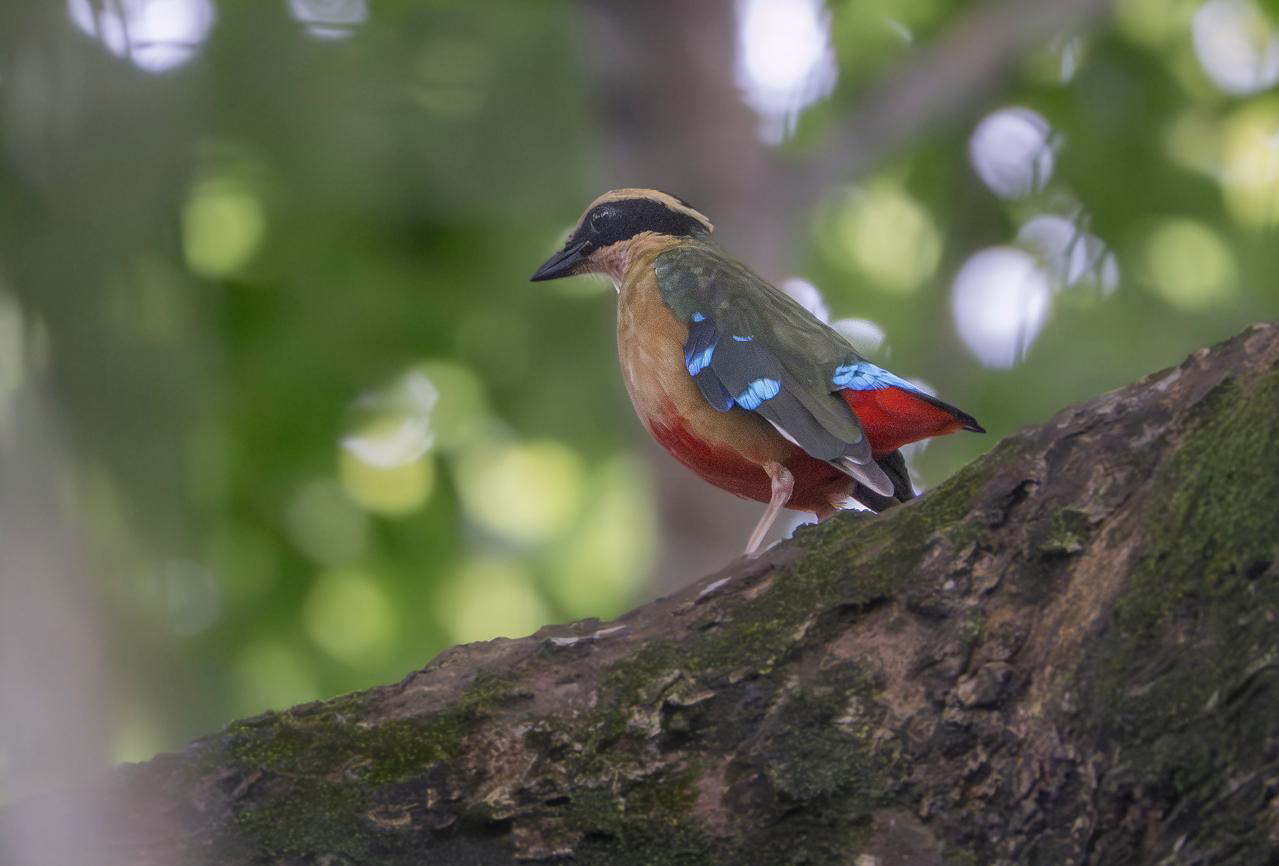
The Afrotropical African Pitta, topping many a birder’s list, arrives in November to breed, its colours and shape making it unique in the region. Its “preert” hopping call can be heard from over a hundred meters away. How José located it in dense thicket remains a mystery.
John’s recent expeditions yielded mixed results in searching for the prized Barred Long-tailed Cuckoo, a rare summer visitor whose population is shrinking due to deforestation. We missed out on this one. We caught its call once, but it could well have been a mimicking Red-capped Robin-Chat.
Although available elsewhere in Africa, the unusual Black-and-white Shrike-Flycatcher reaches the southern edge of its range in Mozambique. The coutadas offer a best-chance Southern African tick. We had a pair displaying in their favoured habitat, a large dead tree at the edge of a clearing. (Picture taken in Semuliki National Park, Uganda.)

The Black-headed Apalis occurs all the way up the continent’s east coast, showing much geographical variation. The coutadas are best placed to showcase them in the region.

Small groups of striking Chestnut-fronted Helmetshrike move through the mid-level canopies of coastal forests all the way to Kenya, often joining Retz’s Helmetshrike. Their distinctive features – chestnut-bristled foreheads, blue eye-wattles, and vivid orange eyes - make them easily recognisable.

The East Coast Akalat is unique in being the only member of its family found in Southern Africa, whereas eight other species are located further north and west. Characterised by apricot to rufous underparts, this charming yet elusive robin moves quietly along the forest floor and in the mid-canopy of lowland primary and secondary forests. We were lucky to see a few, often when we were targeting something else. Inquisitive, they’d perch and peek and then be gone.

The little Green-backed Woodpecker can be found in Zimbabwe’s Eastern Highlands and along coastal Mozambique, inhabiting forests and rich woodlands throughout sub-Saharan Africa to Senegal. Its appearance changes depending on the region. Its short bill and absence of malar stripes set it apart from the slightly larger local rarity, the Speckle-throated Woodpecker - a species we saw but weren’t lucky enough to photograph.

We didn’t spot Kirk’s Francolin, which is now regarded as a local subspecies of the Crested Francolin according to the most recent AviList (the new comprehensive global bird checklist).
The village in Coutada 11 was ideal habitat for the Lemon-breasted Canary, a southeastern African seedeater often found with ilala palms and more abundant here than in South Africa.

Lowland Tiny Greenbuls were more often heard than seen. Their preference for zipping between the darkest thickets made for challenging photography. Expect to use high ISOs and slow shutter speeds and hope for an obliging bird. Perhaps coastal Tanzania’s ones are easier.

Its call and size distinguish it from the larger similar Yellow-streaked Greenbul which we had good views of, especially at the bird bath at Mungari Camp.

This quiet bench is a good place to wait (between outings) for other forest visitors including Red-capped Robin-chat, Blue-mantled Crested Flycatcher, African Pygmy Kingfisher and the elusive White-chested Alethe. Bring your widest-aperture lens.
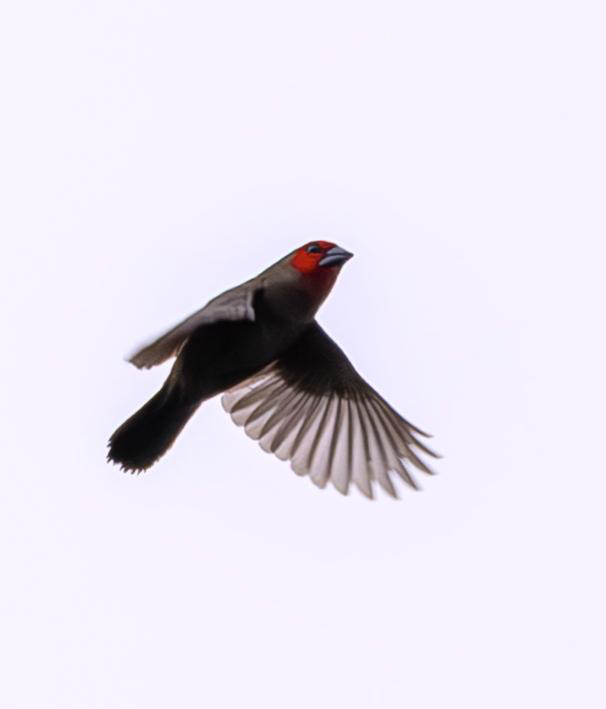
The exquisite Lesser Seedcracker was high on my list (admittedly, it was not alone) and John had a few secret locations. They frequent moist habitats, primarily reedbeds near forest edges. We found a pair, in three attempts, but they were skittish and flushed to perch far away. An unsharp bird in flight photo was all I could muster. They have a patchy distribution which extends into Malawi and Tanzania. Another work in progress.
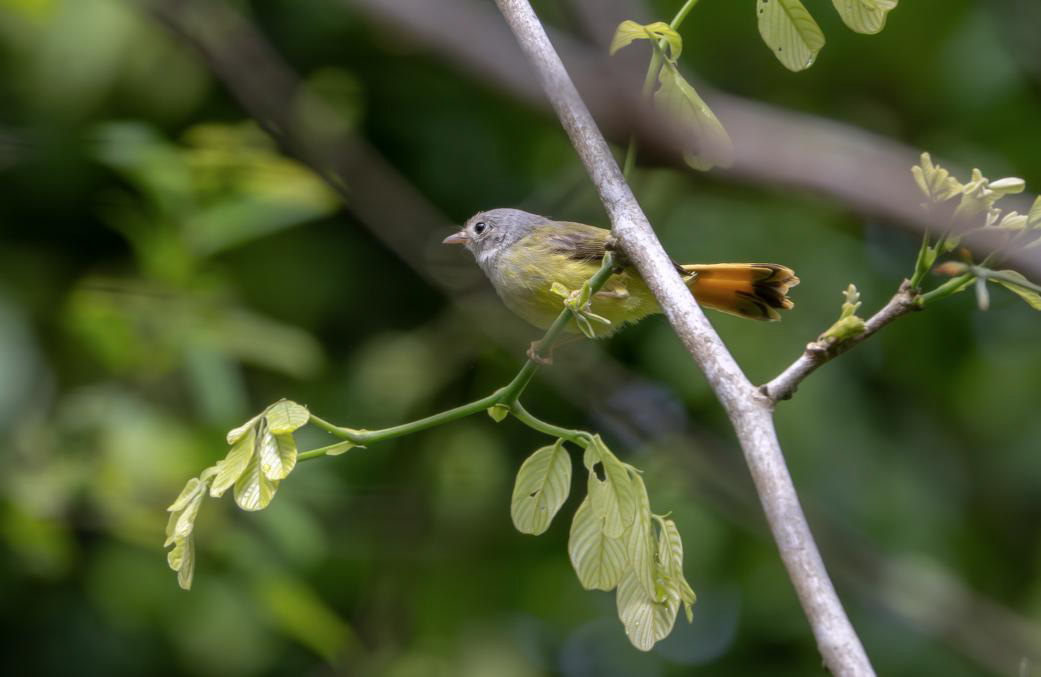
Capturing a photo of the delicate, colourful, and highly active Livingstone’s Flycatcher proved just as challenging. Photographing forest birds is character-building. After several tries I eventually got a reasonable proof-of-existence.
The Silvery-cheeked Hornbill is a big hornbill with a large casque, found from eastern Zimbabwe to Ethiopia. They were common in the coutada. (Picture from the Eastern Highlands.)

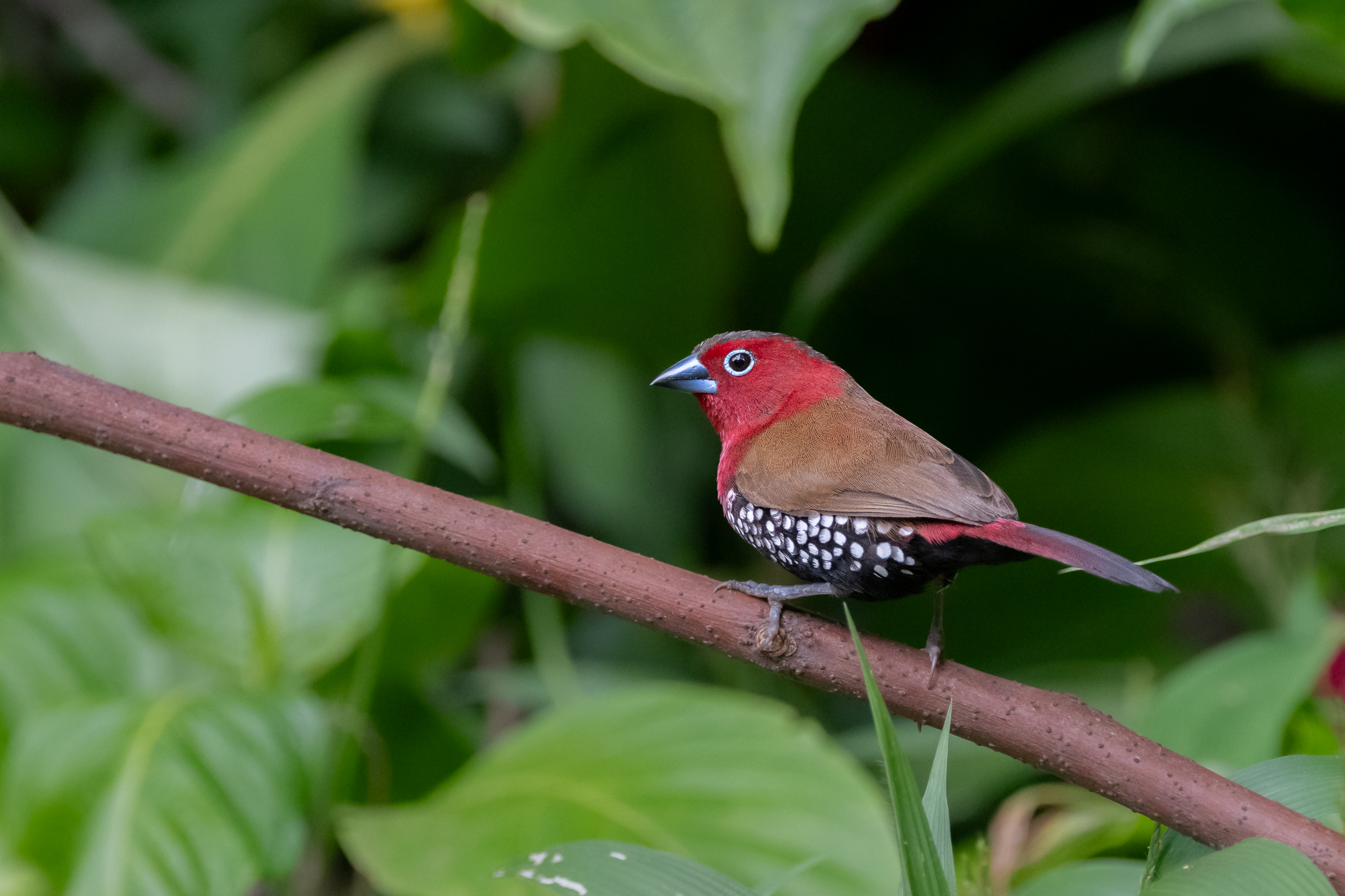
Although usually shy and inconspicuous, the striking Red-throated Twinspot was often seen. These birds are widespread through east and southeastern Africa but difficult to photograph. (This picture was taken in Zimbabwe’s Eastern Highlands.)
During previous visits to northern KwaZulu-Natal, the Southern Banded Snake Eagle gave us the run-around; however, on this trip, sightings occurred almost daily. The prominent dead trees bordering the village provided ideal perches. Although scarce and uncommon, its range extends as far north as coastal Kenya.

The White-chested Alethe proved the most difficult to pin to my memory card. One of the guests saw one at the bird bath but my visits there went unrewarded. We tried their usual territories at least once a day, crouched in the shadows, and had a brief glimpse as one perched and flew off in the same breath. Southern Africa’s only alethe will have to wait until next time.
The two predominantly Mozambican batises (in the region) showed well on a few occasions. Pale Batis (juvenile, on the left) and Woodwards’ Batis (on the right).


Other second-tier specials that are reasonably common in and around Coutada 11 which we saw (or heard) included Plain-backed and Western Violet-backed Sunbird, White-breasted Cuckooshrike, Stierling’s Wren-Warbler, Eurasian and African Golden Oriole, Black-winged Red Bishop, Red-headed Quelea, Southern Hyliota, Palm-nut Vulture, Mangrove Kingfisher, Collared Palm Thrush, African Cuckoo-Hawk, Dickinson’s Kestrel, flocks of Long-toed Lapwings, Bohm’s Spinetail, Red-faced Crombec. We weren’t able to confirm what we hoped was a small flock of Miombo Blue-eared Starlings.
Collared Palm Thrush and Mangrove Kingfisher.


The forest constantly “hoo-hooed” with Narina Trogons. We saw more in those six days than I’ve ever seen before. But we were less fortunate with the Brown-headed and Grey-headed Parrots. They were heard but not well observed.
We enjoyed two or three Crowned Eagle sightings including this confiding individual.

A visit to the area's largest floodplain is a must. High densities of mammals, reminiscent of the Serengeti, including Lichtenstein’s hartebeest, Crawshay’s zebra, southern reedbuck and oribi, occur in numbers not seen further south. Elsewhere, buffalo, waterbuck, sable antelope, suni and red duiker were common, and we spotted a blue duiker – Southern Africa’s smallest antelope - in the nearby sand forest.
John’s Robinson Birding offers an eight-day tour in May, which is split between Coutada 11 and Mount Gorongosa to see the Green-headed Oriole. Given the few that got away and the many more on offer at this inaccessible montane location, it is a trip I hope to take soon.