
Overview
This tiny landlocked nation is sometimes called the Switzerland of Africa, for good reason. The country is tidy, and safe, and its people, hardworking. By African standards, the main roads are in great condition, connecting the centrally located capital, Kigali, to a choice of big-five safari bushveld; a volcanic massif with mountain gorilla; and afro-montane forests in the Albertine Rift Valley hosting numerous endemics birds, and all within a handful of hours from the city. It is a remarkable success story given the trauma that they have had to overcome in the last three decades.
Some friends of ours were working in the capital and invited us to join them for a couple of long weekends away, with city excursions in between. Kigali has world-class coffee, excellent restaurants and hotels, and compelling must-visit museums. There is a lot to keep one busy between getaways.
Rwanda boasts over 700 bird species, 520 of them resident, and 29 Albertine Rift endemics, thanks to its temperate climate and diverse habitats, which include savanna, lakes, wetlands, high mountains, and thick forests.
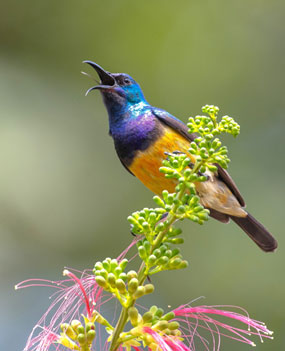
A Variable Sunbird in the lodge’s garden, Kigali
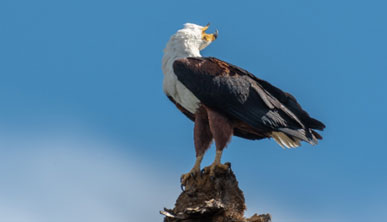
The cry of the African Fish Eagle, Ruzizi Lodge
Akagera National Park
We visited Akagera National Park, some three hours away from the capital, for three days, traversing south to north and back. I was hoping to see the enigmatic Papyrus Gonolek and Shoebill, but they are seldom seen. Highlights included Tambourine Dove, an African Fish Eagle catching a fish and a pair attacking a Goliath Heron, Senegal Lapwing, Black-headed Gonolek, Ross’s Turaco, Rüppel’s Starling, Miombo Wren Warbler and Rufous-bellied Heron. For the latter, book a boat ride on Ihema Lake (Ihema means tented, named after Henry Morton Stanley’s camp on the shore many years ago).
The park’s roads are best navigated by 4x4. We saw four of the big-5. Some of the roads are closed in the wet season when the waters rise. The three lodges we stayed at were all fantastic. Ruzizi Tented Lodge in the south is on the water with boardwalks through tall forest connecting the rooms to the main area, with a restaurant / deck overlooking the lake, and Tanzania in the distance. Great Cormorant, Long-toed Lapwing, Striated Heron and Yellow-rumped Tinkerbird nearby. Karenge Bush Camp is a smaller tented camp up on a hill in the north, serenaded by lions roaring late into the night. Sooty Chat, Coqui Francolin, Yellow-throated Longclaw and Ross’s Turaco en route. A night drive enabled us to photograph some of their nightjars (Square-tailed and Swamp). Trilling Cisticolas in the camp were plentiful. Red-faced Crombec and Flappet Lark at the camp. Northern White-crowned Shrike and African Marsh Harrier in the wetlands below. The Akagera Game Lodge back in the south is also up on a hill and is much bigger, accommodating larger groups. Explore their gardens to find some well-visited bird baths. Angolan Swallow, Crimson-rumped Waxbill and Yellow-whiskered Greenbuls in the gardens.
Kigali
Kigali is a densely populated, hilly city of mixed housing - mud shacks to five-star hotels. The hotspots here were Nyandungu Eco-Park and Umusambi Village, both remarkable success stories. I hired a taxi for the morning and visited both, then a few days later went back to Nyandungu.
The Eco-Park is the culmination of a six-year project to rewild and restore 121 hectares of valley wetland. It includes 10 km of trails, a lovely restaurant with remarkably good coffee, and an information centre. 17,000 indigenous trees were planted. Bird highlights included White-collared Oliveback, Blue-spotted Wood Dove, Copper Sunbird, Spot-flanked Barbet, Winding Cisticola, Klaas’s Cuckoo, Black-lored Babbler, Black-and-white Mannikin, Grey-backed Fiscal and Grey Crowned Cranes.
Umusambi (“crane” in the local language) was established to rehabilitate the crowned cranes that had been confiscated from villagers. Many have been released in Akagera NP and some have bred on the restored wetland reserve. A number of school groups were visiting during the week learning about the cranes and the wider importance of conservation. Additional highlights here, apart from the cranes, included an unexpected African Pitta, Grey-capped Warbler, ubiquitous White-browed Robin Chats and friendly Swamp Flycatchers.
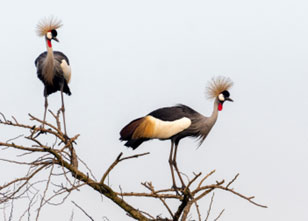
Grey Crowned Cranes, Nyandungu Eco-Park, Kigali
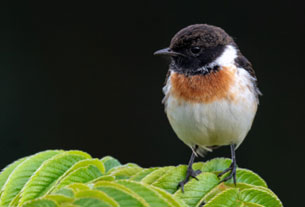
African Stonechat, Ellen DeGeneres Campus near Volcanoes National Park
Volcanoes National Park
We visited Volcanoes National Park to hike the Dian Fossey Tomb trail, a 2 hour walk up to the saddle between Mounts Karisimbi (4507 m asl) and Bisoke. Her research centre – Karisoke – derived its name from these two dormant volcanic peaks. Collect a permit at the headquarters and there’s a chance you may see gorillas en route (we heard them and saw their trackers). As is often the case with forest birding, you hear a lot but see very little. We didn’t hear that much and only saw a few species. You’d need to do a dedicated bird walk here to have more success.
The new Ellen DeGeneres Campus of the Dian Fossey Gorilla Fund on the slopes below the national park are worth a visit, capturing the park’s efforts over the years, summarising much of the research and dedicating a large section to Dian Fossey’s life. The property includes a large re-wilded area where there are some great birding photography opportunities. I had obliging Chubb’s Cisticola, African Yellow Warbler, Long-crested Eagle, White-eyed Slaty Flycatcher, Common Waxbill and Streaky Seedeater.
We decided to take the road less travelled back to Kigali through the Twin Lakes. A 4x4 road crosses the land bridge between the lakes. It is spectacular scenery and gave us good sightings of African Paradise Flycatcher, Augur Buzzard, Black-crowned Waxbill and White-headed Saw-wing.